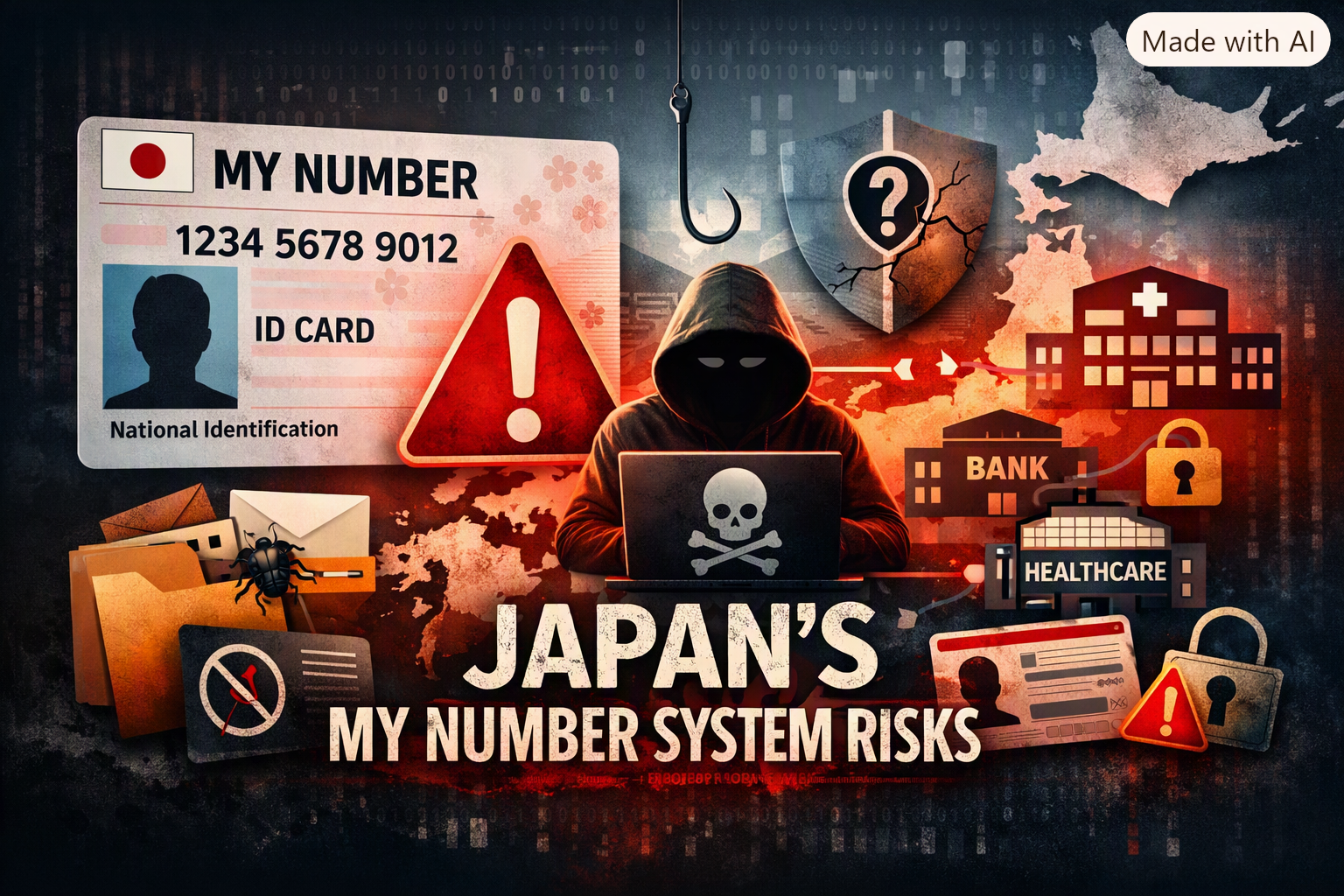
Japan’s My Number system (national ID system launched in 2015) was designed to streamline taxation, social security, and administrative services. However, repeated incidents—including mislinked records, system misconfigurations, and unauthorized access—have exposed structural vulnerabilities in the system.
This section analyzes the risks inherent in My Number, compares Japan’s ID framework with global counterparts, and explains why recent breaches (Digital Agency GSS incident, Times Car data leak) highlight deeper systemic issues.
1. Structural Weaknesses in the My Number System
- 1-1. Fragmented Data Architecture
- 1-2. Over-Reliance on Manual Verification
- 1-3. Weak Identity and Access Management (IAM)
- 1-4. Limited Transparency and Slow Incident Disclosure
- 2-1. Complex Integration with Private Sector
- 2-2. Multi-layer Vendor Ecosystem
- 2-3. Lack of Unified Zero-Trust Architecture
- 3-1. Estonia (eID) — The Global Gold Standard
- 3-2. India (Aadhaar) — Massive Scale, Strong Authentication
- 3-3. United States (SSN) — Legacy System with High Fraud Risk
- 3-4. Japan (My Number) — Hybrid, Fragmented, High Operational Complexity
- 4-1. Mislinked Records Show Systemic Data Integrity Issues
- 4-2. GSS Breach Shows Government IAM Weakness
- 4-3. Times Car Leak Shows Private-Sector Exposure
1-1. Fragmented Data Architecture
Unlike centralized ID systems (Estonia, India), Japan’s My Number data is not stored in a single unified database.
Instead:
- Ministries store their own data
- Local governments store their own data
- Private companies integrate My Number through separate APIs
This fragmentation creates:
- Inconsistent security standards
- Higher risk of misconfiguration
- Difficulty detecting cross-system anomalies
The 2023–2024 mislinking incidents (wrong health insurance data, incorrect pension records) stem directly from this structural fragmentation.
1-2. Over-Reliance on Manual Verification
Many My Number processes still require:
- Manual data entry
- Human verification
- Paper-based workflows
This increases:
- Input errors
- Mislinked records
- Operational delays
- Human-factor security risks
Countries with mature digital ID systems rely on automated validation and cryptographic verification—Japan does not.
1-3. Weak Identity and Access Management (IAM)
The My Number ecosystem involves:
- Government ministries
- Local governments
- Private companies
- Contractors
- Third-party system integrators
Access control varies widely across these entities.
Weak IAM leads to:
- Excessive privileges
- Inconsistent MFA enforcement
- Limited real-time monitoring
- Higher risk of unauthorized access
The Digital Agency GSS breach (246,000 personnel records) is a direct example of IAM weaknesses.
1-4. Limited Transparency and Slow Incident Disclosure
Japan’s ID-related incidents often suffer from:
- Slow public disclosure
- Limited technical detail
- Minimal post-incident reporting
- Lack of cross-agency lessons learned
This reduces public trust and slows systemic improvement.
2. Why My Number Is Prone to Misconfiguration and Data Leakage
2-1. Complex Integration with Private Sector
My Number is used by:
- Banks
- Insurance companies
- Travel companies
- Car-sharing services(Times Car)
- Telecom providers
Each company implements My Number differently, creating uneven security levels across industries.
Times Car’s massive data leak (6.6 million accounts) demonstrated how private-sector integration can expose My Number–related data indirectly.
2-2. Multi-layer Vendor Ecosystem
Government systems often involve:
- Prime contractors
- Secondary subcontractors
- Tertiary subcontractors
This increases:
- Misconfiguration risk
- Slow patching
- Unclear accountability
- Higher exposure to human error
The GSS breach occurred because a contractor’s account was exploited via a vulnerable VPN device.
2-3. Lack of Unified Zero-Trust Architecture
Japan’s ID ecosystem still relies on perimeter security.
Modern ID systems (Estonia, India, UAE) use:
- Continuous authentication
- Real-time anomaly detection
- Centralized IAM
- Cryptographic identity verification
Japan’s hybrid legacy environment makes zero-trust adoption slow and inconsistent.
3. International Comparison: How Japan’s My Number Differs from Global ID Systems
3-1. Estonia (eID) — The Global Gold Standard
- Fully centralized digital identity
- Blockchain-backed integrity
- Mandatory cryptographic authentication
- Real-time monitoring
- Transparent incident reporting
Estonia’s model minimizes mislinking and unauthorized access.
3-2. India (Aadhaar) — Massive Scale, Strong Authentication
- Over 1.3 billion users
- Biometric authentication (fingerprint, iris)
- Unified national database
- Strong API governance
- Rapid incident disclosure
Aadhaar has had breaches, but its centralized architecture allows faster response.
3-3. United States (SSN) — Legacy System with High Fraud Risk
- No centralized digital ID
- SSN widely used across private sector
- High identity theft risk
- No cryptographic verification
Japan’s My Number shares some weaknesses with SSN (fragmentation, private-sector exposure).
3-4. Japan (My Number) — Hybrid, Fragmented, High Operational Complexity
Japan’s system is:
- Not fully centralized
- Integrated across ministries and private companies
- Dependent on legacy systems
- Vulnerable to misconfiguration
- Slow to adopt zero-trust models
This hybrid structure increases both operational risk and security risk.
4. What Recent Incidents Reveal About My Number’s Future Risks
4-1. Mislinked Records Show Systemic Data Integrity Issues
Health insurance mislinks Pension record errors Residence certificate mismatches
These are not isolated mistakes—they reveal structural flaws.
4-2. GSS Breach Shows Government IAM Weakness
Unauthorized access to 246,000 personnel records VPN vulnerability exploitation Contractor account misuse
This indicates systemic IAM gaps.
4-3. Times Car Leak Shows Private-Sector Exposure
6.6 million accounts affected 1.6 million driver’s license images Weak API governance Insufficient vendor oversight
My Number data is indirectly exposed through private-sector integrations.
Conclusion
Japan’s My Number system faces deep structural risks:
- Fragmented architecture
- Weak IAM
- Manual verification
- Multi-layer vendor chains
- Slow incident disclosure
- Hybrid legacy environments
Compared with global ID systems, Japan’s model is more complex, less centralized, and more prone to misconfiguration.
Recent incidents—Digital Agency GSS breach, Times Car leak, mislinked My Number records— are not isolated failures but symptoms of systemic vulnerabilities.

コメント