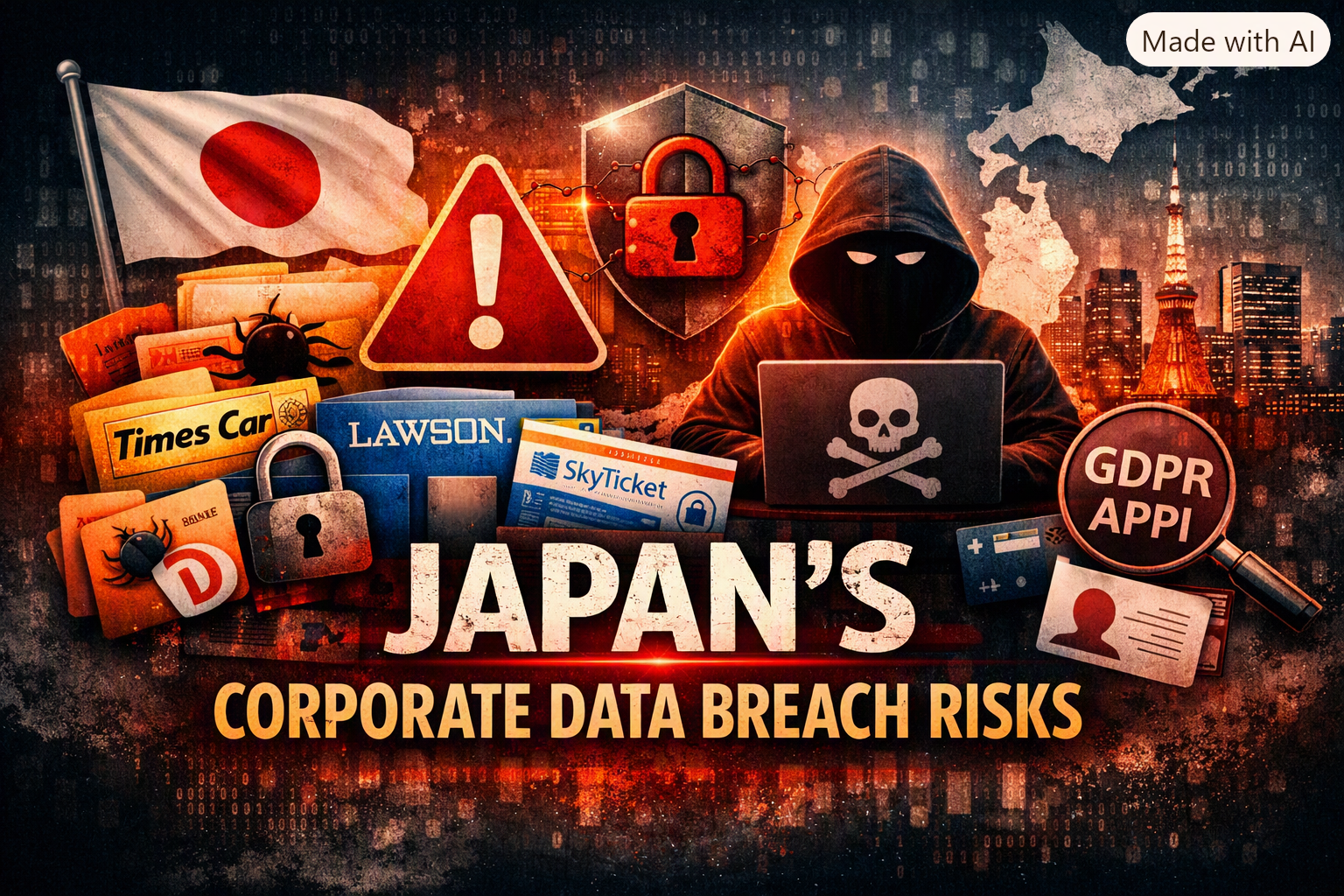
Japan has witnessed a series of high‑profile corporate data breaches in recent years— from Times Car and Lawson to Yakiniku King and SkyTicket. While each case differs in scale and industry, they share strikingly similar patterns of failure. This section analyzes the common causes, cultural factors, and legal gaps that make Japanese companies vulnerable to recurring information leaks.
1. Overview of Major Incidents
| Company | Industry | Year | Estimated Records Exposed | Primary Cause |
|---|---|---|---|---|
| Times Car | Mobility / Car Sharing | 2025 | 6.6 million | Misconfigured cloud storage & weak API access |
| Lawson | Retail / Convenience Stores | 2025 | 1.2 million | Third‑party system mismanagement |
| Yakiniku King | Food Service | 2025 | 0.8 million | Reservation system vulnerability |
| SkyTicket | Travel / Booking | 2024 | 7.5 million | Server misconfiguration & insufficient encryption |
These incidents collectively reveal systemic weaknesses in Japan’s corporate data governance.
2. Common Technical and Organizational Weaknesses
2‑1. Poor Access Control
Many companies grant excessive privileges to external vendors and internal staff. Audit logs are rarely reviewed, and multi‑factor authentication is inconsistently applied.
2‑2. Insufficient Encryption and Cloud Misconfiguration
Sensitive data—such as customer IDs, payment details, and reservation records—was stored in plaintext or misconfigured cloud buckets accessible from the internet.
2‑3. Lack of Continuous Monitoring
Japanese firms often rely on periodic audits rather than real‑time threat detection, allowing breaches to go unnoticed for weeks or months.
2‑4. Vendor Dependency
Outsourced IT operations create fragmented accountability. When a breach occurs, responsibility between the client and vendor becomes blurred.
3. Cultural and Structural Factors
3‑1. Risk Avoidance and Slow Disclosure
Japanese corporate culture prioritizes reputation protection. Companies tend to delay public disclosure until internal investigations are complete, which contrasts sharply with Western transparency norms.
3‑2. Compliance Over Security
Many organizations focus on formal compliance with Japan’s Personal Information Protection Law (APPI) rather than proactive security measures. This “checklist mentality” leads to minimal real‑world protection.
3‑3. Hierarchical Decision‑Making
Security engineers often lack authority to implement urgent fixes without executive approval, slowing response times during active incidents.
4. Legal and Regulatory Context
4‑1. APPI vs. GDPR
Japan’s Act on the Protection of Personal Information (APPI) emphasizes consent and notification, but lacks strong enforcement mechanisms compared to the EU’s GDPR, which imposes heavy fines and mandatory breach reporting.
4‑2. Limited Penalties
Under APPI, penalties for corporate data leaks are relatively light— often administrative guidance rather than financial sanctions. This reduces deterrence and accountability.
4‑3. Fragmented Oversight
Multiple ministries oversee different sectors, creating inconsistent enforcement and slow cross‑industry coordination.
5. International Comparison
| Country | Enforcement Strength | Mandatory Breach Reporting | Cultural Transparency |
|---|---|---|---|
| Japan | Moderate | Partial | Low |
| EU (GDPR) | Strong | Mandatory | High |
| US | Strong (state‑level) | Mandatory | Moderate |
| Singapore | Strong | Mandatory | High |
Japan’s relatively weak enforcement and cultural reluctance toward disclosure make it an outlier among advanced economies.
6. Lessons from the Times Car and Digital Agency Cases
Both incidents highlight the convergence of public and private sector vulnerabilities:
- Over‑reliance on contractors
- Weak IAM and monitoring
- Delayed disclosure
- Insufficient encryption
These patterns suggest that Japan’s digital transformation—both governmental and corporate— requires a unified national cybersecurity framework.
7. Path Forward for Japanese Companies
To rebuild trust and resilience, companies must:
- Adopt zero‑trust architecture
- Enforce strict IAM and MFA policies
- Conduct continuous vulnerability scanning
- Establish transparent breach‑reporting protocols
- Integrate cybersecurity into corporate governance
Conclusion
Japan’s corporate data breaches are not isolated technical failures— they reflect systemic cultural and structural weaknesses in risk management, vendor oversight, and regulatory enforcement. Until transparency and accountability become embedded in corporate culture, similar incidents will continue to undermine Japan’s digital credibility on the global stage.
コメント