- Introduction
- 1. Background: System Disruption on September 26
- 2. Qilin’s Claim and Data Leak Announcement
- 3. What the 27 Leaked Documents Contain (Under Verification)
- 4. The Meaning Behind Qilin’s Countdown Timer
- 5. Qilin’s Use of AI to Automate Attacks
- 6. Broader Implications for Japan’s Infrastructure
- 7. Keio’s Response and Ongoing Investigation
- Conclusion
Introduction
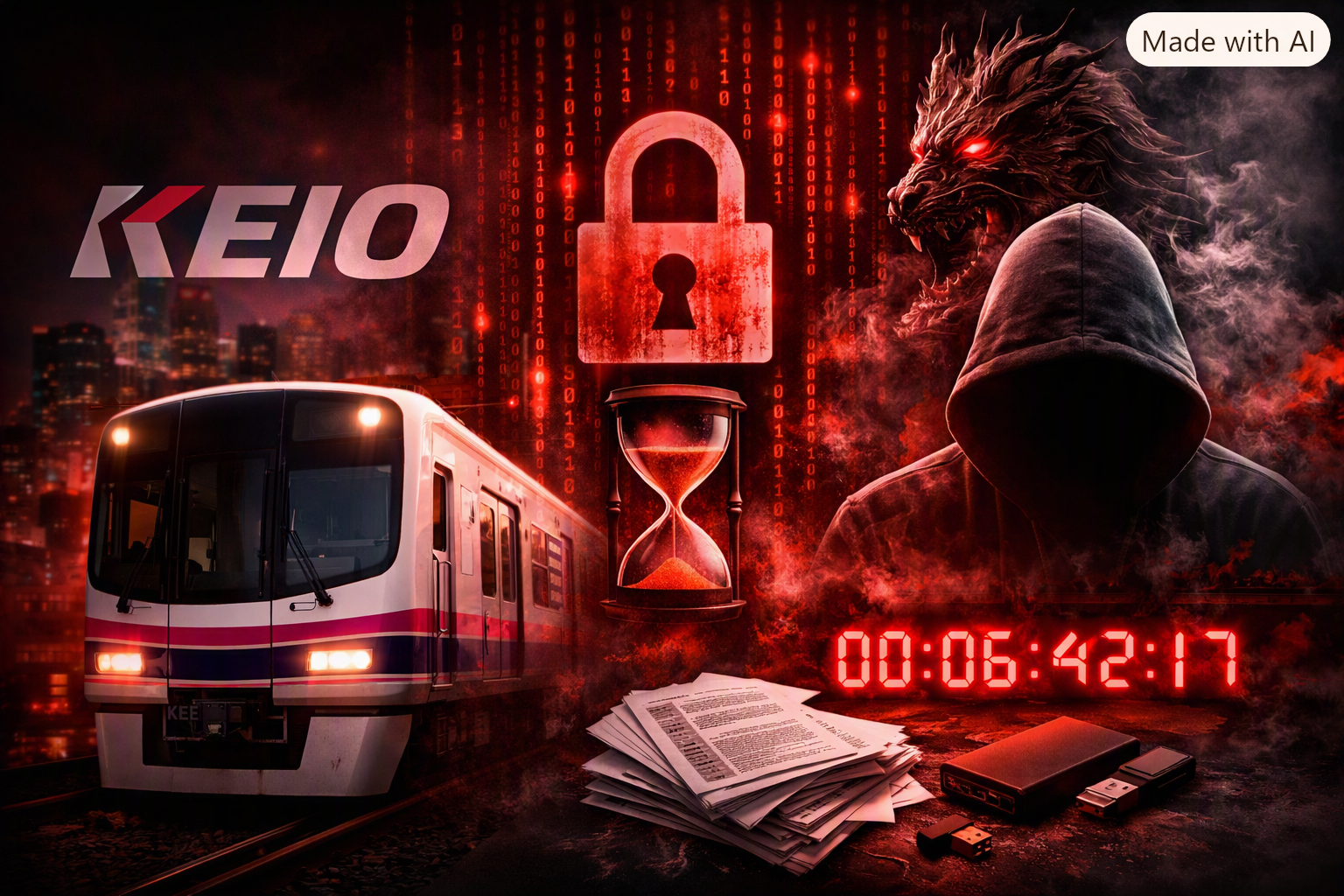
On October 16, 2026, the international hacker group Qilin claimed responsibility for a ransomware attack targeting the Keio Group, one of Japan’s major railway and retail conglomerates. The group published 27 images of alleged internal documents on its leak site and displayed a countdown timer, suggesting a deadline for full data disclosure. Keio Corporation confirmed that it is investigating the authenticity of the leaked materials and has not yet verified any personal data breach.
This article summarizes the known facts, analyzes the meaning behind Qilin’s countdown, and explores what this incident reveals about Japan’s cybersecurity vulnerabilities.
1. Background: System Disruption on September 26
Keio Group reported a system failure caused by unauthorized access in the early hours of September 26. The attack affected multiple services across the group:
- Hotel reservation systems at Keio Plaza Hotel
- Payment systems at Keio Store
- Internal email servers
- Corporate network infrastructure
While train operations remained unaffected, the incident disrupted essential consumer services, highlighting the interconnected nature of modern infrastructure.
2. Qilin’s Claim and Data Leak Announcement
On October 16, Qilin added a new entry titled “KEIO CORPORATION” to its leak site. The post included:
- 27 images of alleged internal documents
- A countdown timer indicating a deadline for full disclosure
- Samples of contracts, internal emails, and HR-related materials
- A statement claiming that Keio’s data had been exfiltrated
Keio Corporation responded publicly:
“We have confirmed that a group claiming responsibility has published what it describes as our internal information. However, we are still verifying whether these materials are genuine.”
At this stage, no confirmed personal data leak has been reported.
3. What the 27 Leaked Documents Contain (Under Verification)
The leaked materials reportedly include:
- Business contracts and internal correspondence
- Employee-related documents and meeting notes
- Workflow charts and operational manuals
- Files containing names and email addresses
Keio has not verified the authenticity of these files. The discrepancy between Qilin’s claims and Keio’s official statements reflects the typical uncertainty phase following a ransomware disclosure.
4. The Meaning Behind Qilin’s Countdown Timer
The countdown displayed on Qilin’s site represents a classic “double extortion” tactic — a hallmark of modern ransomware operations.
Double Extortion Explained
- Encrypt the victim’s systems to halt operations.
- Threaten to publish stolen data unless ransom is paid.
The timer serves as a psychological pressure mechanism, signaling that if negotiations fail, the stolen data will be released publicly. This approach has become increasingly common among ransomware groups seeking both financial gain and media attention.
5. Qilin’s Use of AI to Automate Attacks
In an interview with TBS NEWS DIG on October 15, Qilin stated that it uses a proprietary AI model to accelerate attacks:
- AI shortens the time required for initial infiltration.
- The number of weekly targets has increased from dozens to hundreds.
- Japanese corporations and municipalities have become frequent victims.
The Keio incident may be one of the first large-scale cases in Japan involving AI-assisted ransomware deployment.
6. Broader Implications for Japan’s Infrastructure
This attack exposes several structural weaknesses in Japan’s digital ecosystem:
1. Supply Chain Vulnerability
Compromising a single vendor can disrupt multiple sectors — transportation, hospitality, and retail simultaneously.
2. Limitations of Perimeter Defense
Email, payment, and reservation systems were affected concurrently, suggesting insufficient segmentation.
3. Normalization of Double Extortion
Data encryption and public exposure threats are now standard practice among ransomware groups.
7. Keio’s Response and Ongoing Investigation
Keio Corporation continues to:
- Collaborate with law enforcement and cybersecurity experts
- Verify the authenticity of the leaked materials
- Assess potential personal data exposure
- Restore affected systems
- Issue updates as new information becomes available
The investigation will focus on the attack vector, the scope of data exfiltration, and the validity of Qilin’s claims.
Conclusion
The Qilin ransomware attack against Keio Group marks a significant escalation in cyber threats targeting Japan’s critical infrastructure. It combines AI-driven automation, double extortion tactics, and public data leaks — a dangerous blend that challenges traditional security models.
While Keio’s train operations remain unaffected, the incident underscores how deeply digital systems are woven into everyday life. For Japan, this is not merely a corporate breach — it is a warning that cyber resilience must now be treated as part of national infrastructure protection.
コメント