Comparing Two Nations’ Approaches to Space Exploration and Economic Growth
1. Introduction
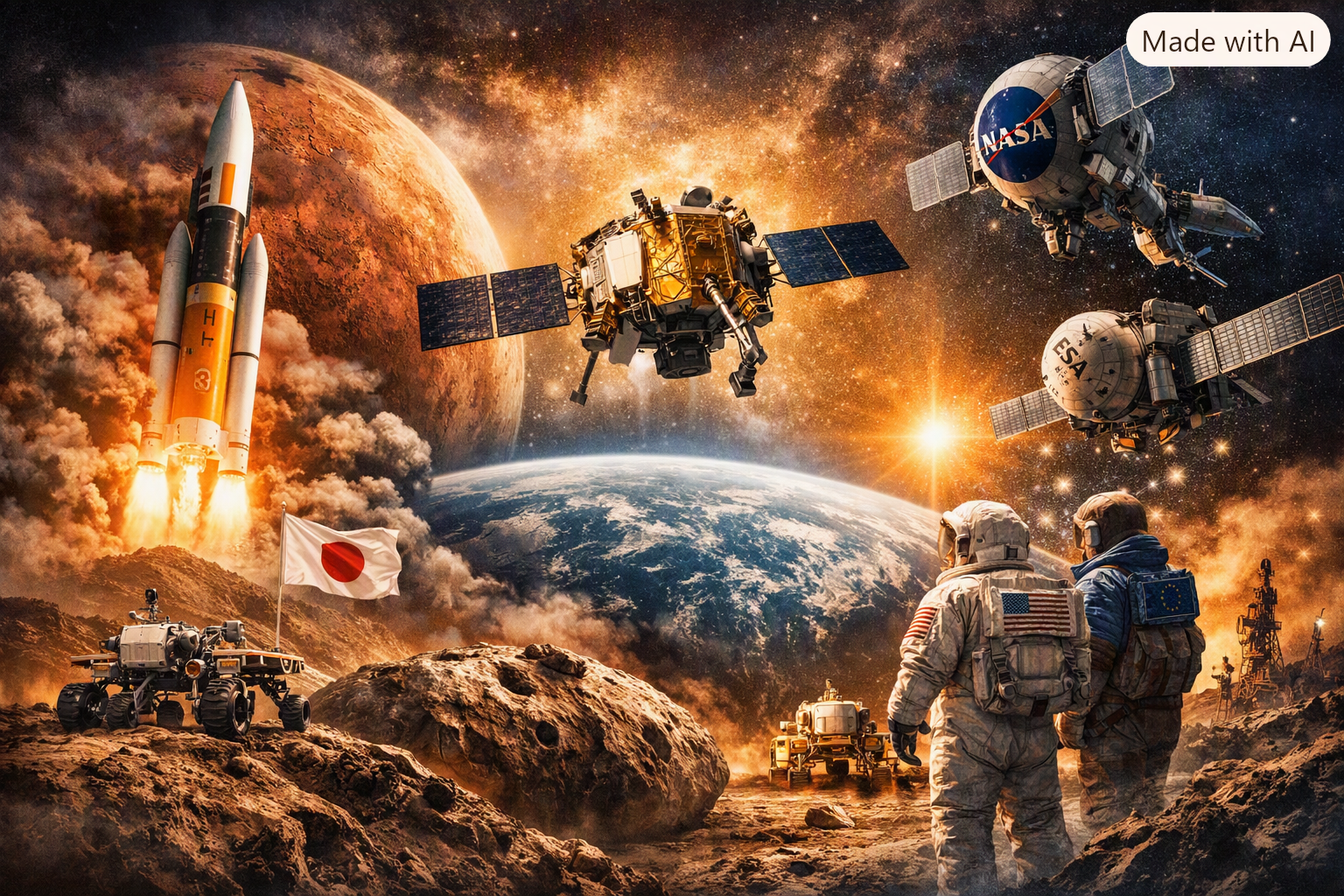
Space exploration has become a defining element of national strategy — not only for science but also for economic growth and global influence. Japan and the United States represent two contrasting models: one built on cooperation and precision, the other on innovation and dominance. This article explores how their different approaches shape technological progress, industrial development, and long‑term economic outcomes.
2. Strategic Philosophy
2.1 Japan: Cooperation and Stability
Japan’s space policy emphasizes peaceful use, scientific collaboration, and international trust. JAXA operates as a cooperative agency, working closely with NASA, ESA, and CNES. Its missions — such as MMX (Martian Moons eXploration) — reflect Japan’s diplomatic and scientific balance.
2.2 United States: Leadership and Competition
The U.S. approach, led by NASA and private giants like SpaceX and Blue Origin, focuses on technological leadership and strategic dominance. Space exploration is intertwined with national security, economic expansion, and global influence. The Artemis program symbolizes America’s ambition to lead humanity back to the Moon and beyond.
3. Economic Models
| Aspect | Japan | United States |
|---|---|---|
| Market Size (2026) | ¥4 trillion | $400 billion |
| Private Sector Share | ~40% | ~80% |
| Government Support | Space Strategy Fund (¥1 trillion over 10 years) | NASA + Defense budgets |
| Investment Structure | Public funding + industrial collaboration | Venture capital + private innovation |
Japan’s model is state‑supported and collaborative, while the U.S. model is market‑driven and entrepreneurial. Both generate strong innovation, but through different mechanisms.
4. Technological Focus
4.1 Japan: Precision and Reliability
Japan excels in:
- Autonomous navigation
- Miniaturized sensors
- Radiation‑resistant electronics
- High‑accuracy observation satellites
These technologies feed into civilian industries — automotive, AI, disaster prevention, and telecommunications — creating broad economic ripple effects.
4.2 United States: Scale and Speed
The U.S. focuses on:
- Heavy‑lift rockets
- Human spaceflight
- Space logistics and tourism
- AI‑driven mission control
Its innovation cycle is faster, risk‑tolerant, and commercially oriented. SpaceX’s reusable rockets and Starlink network exemplify the “move fast and scale globally” philosophy.
5. Cultural and Diplomatic Dimensions
| Aspect | Japan | United States |
|---|---|---|
| Space Vision | Scientific, ethical, cooperative | Competitive, pioneering, leadership‑driven |
| International Cooperation | Multilateral (ESA, CNES, NASA) | Bilateral or U.S.‑led |
| Public Image | “Quiet leadership” | “Frontier spirit” |
| Media Narrative | Precision and trust | Innovation and ambition |
Japan’s diplomacy builds stability; America’s narrative drives momentum. Both contribute to global progress, but through distinct cultural lenses.
6. Economic Impact Comparison
6.1 Japan: Ripple‑Effect Economy
Space exploration strengthens Japan’s economy indirectly through:
- Industrial diversification
- Technology transfer
- Employment growth
- Export of high‑precision components
Japan’s space sector acts as a catalyst for broader industrial evolution.
6.2 United States: Pull‑Effect Economy
The U.S. space industry directly drives GDP growth through:
- Commercial launches
- Satellite internet services
- Space tourism
- Defense contracts
It functions as a core economic engine, not just a scientific field.
7. Conclusion
Japan and the United States pursue space exploration with different philosophies — cooperation versus competition, precision versus scale. Yet both share a common truth: space is the next frontier of economic power.
Japan’s calm reliability and America’s bold innovation are shaping two complementary paths toward the same goal — a sustainable, prosperous space economy.

コメント