How JAXA’s MMX Redefines International Space Exploration
1. Introduction
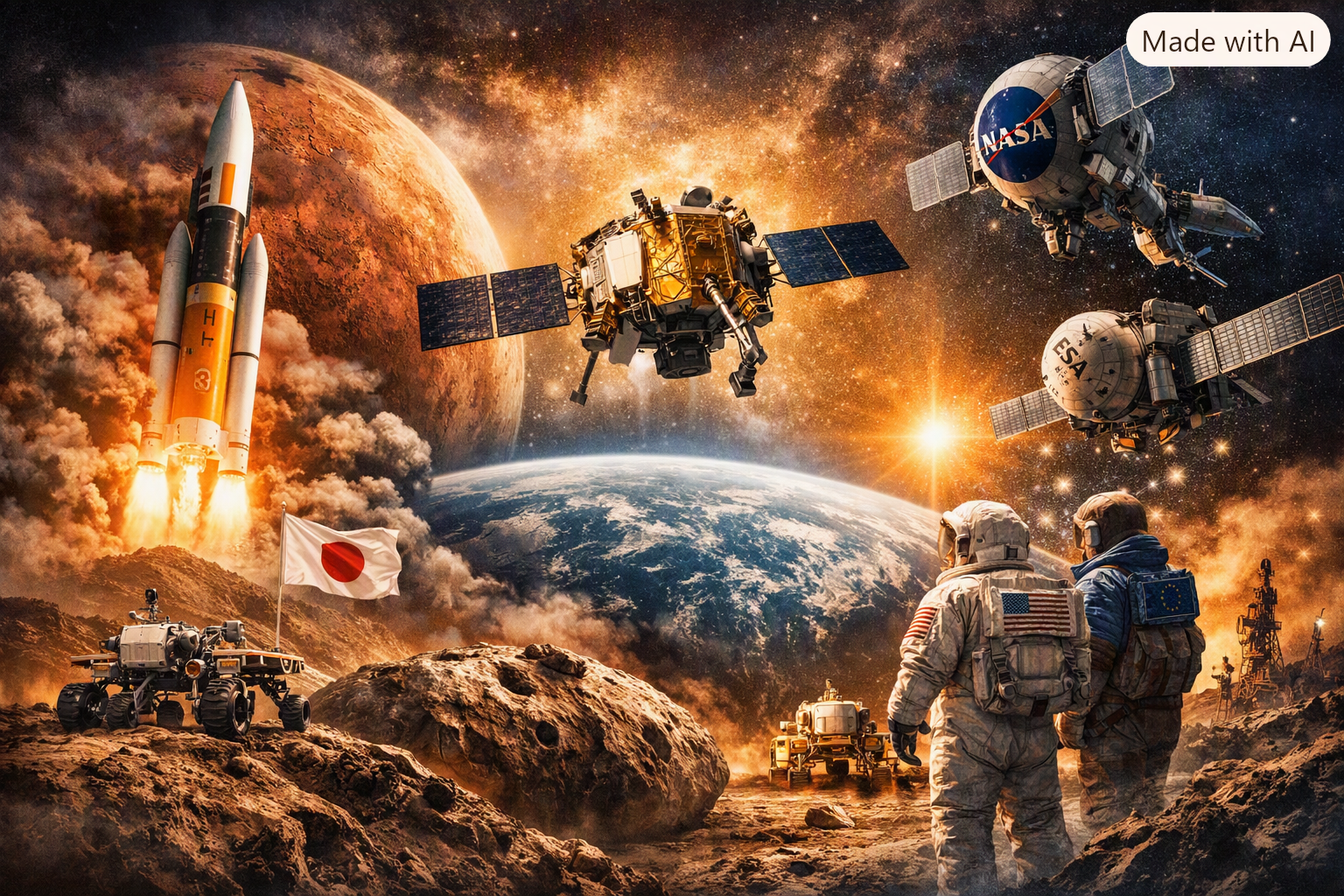
Japan’s Martian Moons eXploration (MMX) mission marks one of the most ambitious space projects ever attempted: a sample‑return mission from Phobos, the larger moon of Mars. Launched by JAXA in collaboration with NASA, ESA, and CNES, MMX represents a new era of international space cooperation — one where Japan plays a central, stabilizing role.
As global tensions rise and geopolitical competition intensifies, Japan’s quiet leadership in space exploration is becoming increasingly important. MMX is not just a scientific mission; it is a diplomatic and technological milestone that strengthens Japan’s position in the global space community.
2. Japan’s Role in Global Space Collaboration
2.1 A New Center of International Cooperation
Japan has become a key partner for major space agencies:
- NASA provides navigation and scientific support
- ESA contributes deep‑space communication systems
- CNES co‑developed the rover that will land on Phobos
This multi‑agency collaboration reflects a growing trend: Japan is now seen as a reliable, neutral, and technologically precise leader in space exploration.
2.2 Why Japan’s Leadership Matters
Japan’s involvement brings:
- Engineering reliability
- Mission stability
- Political neutrality
- Long‑term commitment to scientific goals
In an era where space exploration is often influenced by geopolitical rivalry, Japan’s calm and cooperative approach is highly valued.
3. Technical Innovations of the MMX Mission
3.1 World’s First Phobos Sample‑Return
MMX aims to collect material from Phobos and return it to Earth — a world‑first achievement. The mission will help scientists understand:
- The origin of Mars’ moons
- The early solar system
- Potential resources for future human exploration
3.2 The CNES–JAXA Rover
A small autonomous rover, co‑developed with CNES, will:
- Navigate Phobos’ low‑gravity surface
- Capture high‑resolution images
- Analyze soil composition
- Support sample‑collection operations
This rover is the first vehicle ever designed to move on a Martian moon.
3.3 Advanced Sample‑Return Technology
MMX uses:
- Precision landing systems
- Autonomous navigation
- High‑efficiency propulsion
- Radiation‑resistant electronics
These technologies will influence future missions to Mars, asteroids, and beyond.
4. International Partnerships Strengthened by MMX
4.1 NASA’s Strategic Support
NASA’s involvement signals strong U.S.–Japan cooperation in deep‑space exploration. The partnership includes:
- Navigation assistance
- Scientific analysis
- Shared mission data
- Joint research on Mars’ evolution
4.2 ESA’s Communication Infrastructure
ESA provides critical communication links that allow MMX to operate across vast distances. This collaboration strengthens Europe–Japan scientific ties.
4.3 CNES and the Phobos Rover
France’s CNES plays a major role through the rover project. This partnership showcases Japan’s ability to coordinate complex multinational engineering efforts.
5. Scientific and Diplomatic Implications
5.1 Scientific Breakthroughs
MMX could answer key questions:
- Are Mars’ moons captured asteroids or remnants of a giant impact?
- What materials exist on Phobos that could support future missions?
- How did the early solar system evolve?
The mission’s findings may reshape planetary science.
5.2 Diplomatic Significance
Japan’s leadership in MMX strengthens:
- International trust
- Scientific diplomacy
- Global cooperation in peaceful space exploration
In a world where space is increasingly militarized, Japan’s role as a stabilizing force is crucial.
6. Japan’s Future Space Vision
6.1 Beyond MMX
Japan is planning:
- Lunar surface missions
- Deep‑space probes
- Advanced asteroid exploration
- Human‑support technologies for Mars missions
6.2 Japan’s Long‑Term Strategy
Japan aims to:
- Lead Asia’s space race
- Expand international partnerships
- Develop sustainable exploration technologies
- Promote peaceful use of outer space
MMX is the foundation for Japan’s next decade of exploration.
7. Conclusion
Japan’s MMX mission is more than a scientific endeavor — it is a symbol of Japan’s rising influence in global space exploration. Through precise engineering, diplomatic cooperation, and long‑term vision, Japan is redefining how nations work together beyond Earth.
As the world faces geopolitical uncertainty, Japan’s calm, collaborative leadership in space offers a model for the future.
MMX is not just a mission to Phobos. It is a mission that strengthens global unity.

コメント