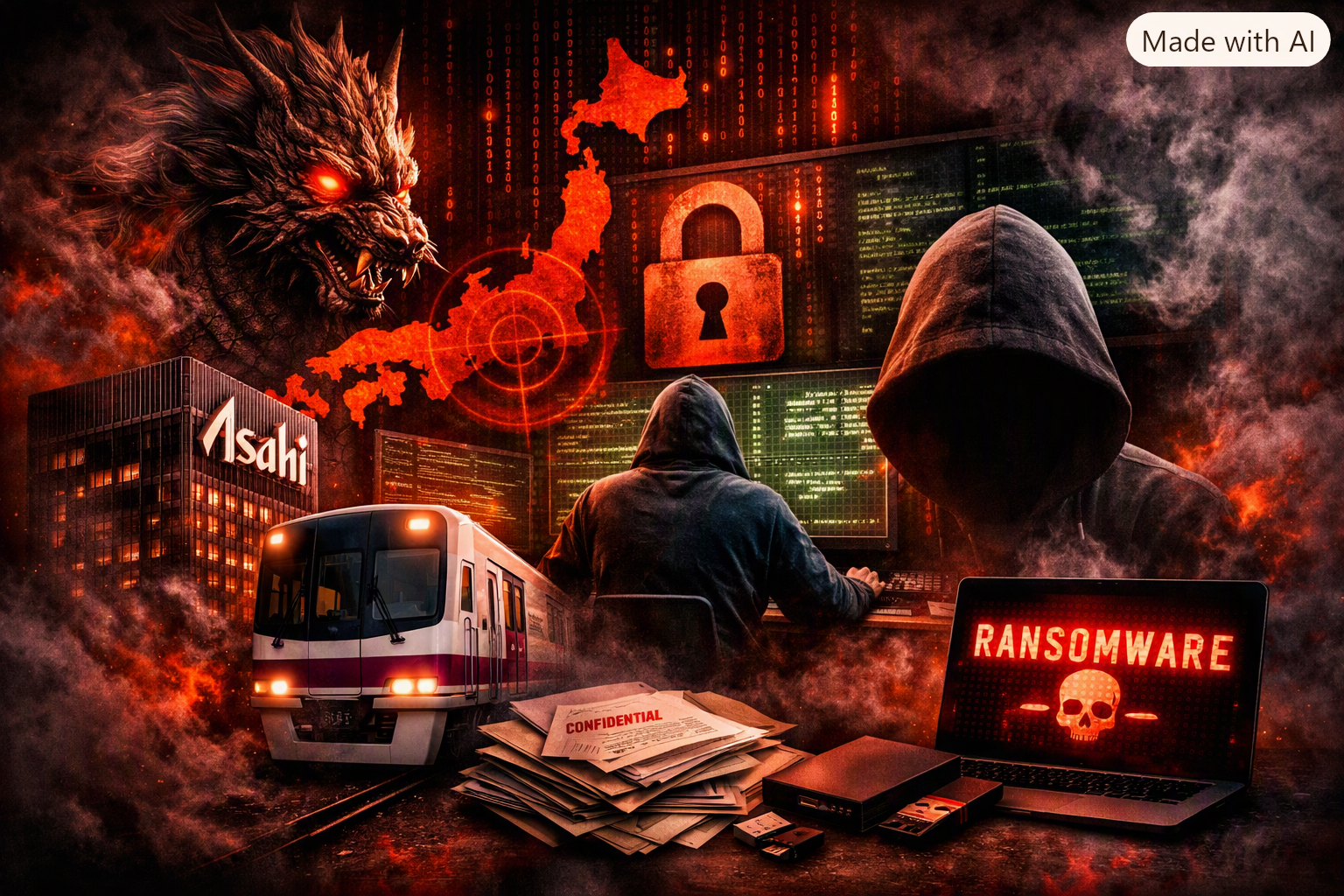
- Introduction: Why the Keio Incident Represents a National-Level Cybersecurity Turning Point
- 1.1 Shared Identity & Access Management (IAM)
- 1.2 Hybrid Vulnerability: Legacy + Cloud
- 2.1 Initial Breach (September 26)
- 2.2 Lateral Movement
- 2.3 Data Exfiltration
- 2.4 Double Extortion
- 3.1 Technical Implications
- 5.1 Asahi Group Holdings
- 5.2 Arcadia (Municipal Email Contractor)
- 5.3 Pattern Recognition
- 6.1 Initial Infiltration
- 6.2 Lateral Movement
- 6.3 Data Exfiltration
- 6.4 Ransom Negotiation
- 7.1 IT Outsourcing Dependency
- 7.2 Weak Network Segmentation
- 7.3 Slow Patch Cycles
- 7.4 Underinvestment in Cybersecurity
Introduction: Why the Keio Incident Represents a National-Level Cybersecurity Turning Point
The ransomware attack against Keio Group, a major Japanese railway and retail conglomerate, is not simply another corporate breach. It is a strategic intrusion into transportation-adjacent digital infrastructure, executed by Qilin — a ransomware gang known for AI-driven automation, aggressive double extortion, and supply-chain exploitation.
Unlike typical ransomware cases, the Keio incident exposes:
- Weak segmentation between railway-adjacent digital systems
- Structural vulnerabilities in Japan’s IT outsourcing model
- The growing use of AI for lateral movement and privilege escalation
- The risk of “non-operational disruption” (trains run, but services collapse)
- The fragility of Japan’s public-service digital ecosystem
This case study analyzes the attack from technical, organizational, and infrastructure-level perspectives.
1. Infrastructure Context: Why Keio Group Is a High-Value Target
Keio Group operates:
- Major commuter railway lines in Tokyo
- Keio Plaza Hotel (international tourist hub)
- Keio Store retail chain
- Digital reservation, payment, and logistics systems
- Shared corporate IT infrastructure across subsidiaries
This multi-sector structure creates a broad and interconnected attack surface.
1.1 Shared Identity & Access Management (IAM)
Japanese conglomerates often use unified IAM across subsidiaries. A single compromised domain controller or VPN credential can allow attackers to pivot across:
- Hotel systems
- Retail POS networks
- Corporate email
- Internal file servers
1.2 Hybrid Vulnerability: Legacy + Cloud
Railway companies frequently operate:
- Legacy on-prem servers
- Vendor-managed reservation systems
- Cloud-based hotel booking platforms
- Retail POS systems running outdated Windows builds
This hybrid environment is difficult to secure and easy to exploit.
2. Attack Timeline: Reconstructed Technical Sequence
2.1 Initial Breach (September 26)
Keio reported unauthorized access. Based on Qilin’s known TTPs, likely entry vectors include:
- Compromised VPN credentials
- SSL-VPN vulnerabilities (Fortinet, Pulse Secure, SonicWall)
- Phishing targeting hotel or retail staff
- Supply-chain compromise via IT vendor
2.2 Lateral Movement
Once inside, Qilin likely used:
- BloodHound for AD privilege mapping
- Kerberoasting for privilege escalation
- RDP pivoting across internal servers
- AI-driven scripts to identify high-value systems
2.3 Data Exfiltration
The 27 leaked documents suggest access to:
- HR systems
- Contract repositories
- Internal workflow documentation
- Email servers
Qilin typically uses:
- Rclone
- Mega.nz
- Wasabi cloud storage
- AI-driven compression routines
2.4 Double Extortion
Although Keio did not report encryption, the countdown timer indicates:
- Negotiation attempt
- Threat of full data release
- Pressure to pay ransom
3. Deep Analysis of the 27 Leaked Documents
The leaked materials include:
- Contract PDFs
- HR spreadsheets
- Internal emails
- Workflow charts
- Operational manuals
3.1 Technical Implications
These files imply access to:
- File servers
- Email servers (Exchange / M365)
- Document management systems
- Shared drives across subsidiaries
This suggests domain-level compromise, not a superficial breach.
4. Why Train Operations Were Not Disrupted
Railway operations typically run on:
- Isolated OT networks
- Proprietary signaling systems
- Air-gapped control servers
Keio’s operational technology (OT) was likely segmented from:
- Hotel systems
- Retail POS
- Corporate IT
However, digital services supporting passengers were disrupted:
- Reservations
- Payments
- Email communication
- Logistics coordination
This is known as “non-operational disruption” — the trains run, but the ecosystem collapses.
5. Comparison with Other Qilin Attacks in Japan
5.1 Asahi Group Holdings
Qilin published a statement claiming responsibility, suggesting deep infiltration.
5.2 Arcadia (Municipal Email Contractor)
- Over 3 million email addresses exposed
- Emergency alert systems suspended
- Multiple municipalities affected
5.3 Pattern Recognition
Qilin is strategically targeting:
- Public-service providers
- Railway-adjacent companies
- Municipal contractors
- Conglomerates with shared IT infrastructure
This is intentional, not random.
6. Qilin’s AI-Driven Attack Model
Qilin admitted to using a proprietary AI model for:
6.1 Initial Infiltration
- Automated credential testing
- AI-personalized phishing
- Rapid vulnerability scanning
6.2 Lateral Movement
- Automated privilege escalation
- Real-time AD graph analysis
- AI-based identification of high-value servers
6.3 Data Exfiltration
- AI-optimized compression
- Automated file categorization
- Prioritization of sensitive documents
6.4 Ransom Negotiation
- AI-generated ransom communication
- Psychological profiling
- Dynamic ransom pricing
Qilin is one of the first AI-native ransomware groups.
7. Japan’s Structural Weaknesses
7.1 IT Outsourcing Dependency
Many Japanese companies outsource:
- SOC
- Server management
- Email systems
- VPN maintenance
- Cloud migration
A breach in one vendor can cause nationwide ripple effects.
7.2 Weak Network Segmentation
Retail, hotel, and railway IT systems are often logically connected, increasing blast radius.
7.3 Slow Patch Cycles
Railway and municipal systems:
- Rely on legacy infrastructure
- Have long operational lifespans
- Apply patches slowly
7.4 Underinvestment in Cybersecurity
Many railway operators:
- Have limited cybersecurity budgets
- Rely heavily on external contractors
- Lack internal SOC expertise
Conclusion: The Keio Incident as a National Cybersecurity Turning Point
The Keio Group attack demonstrates:
- AI-driven ransomware is now targeting public infrastructure
- Supply-chain vulnerabilities can cripple multiple sectors
- Railway operators must treat cybersecurity as critical infrastructure protection
- Japan’s digital ecosystem is entering a new era of high-speed cyber threats
This incident is not just a corporate breach — it is a national-level warning.

コメント