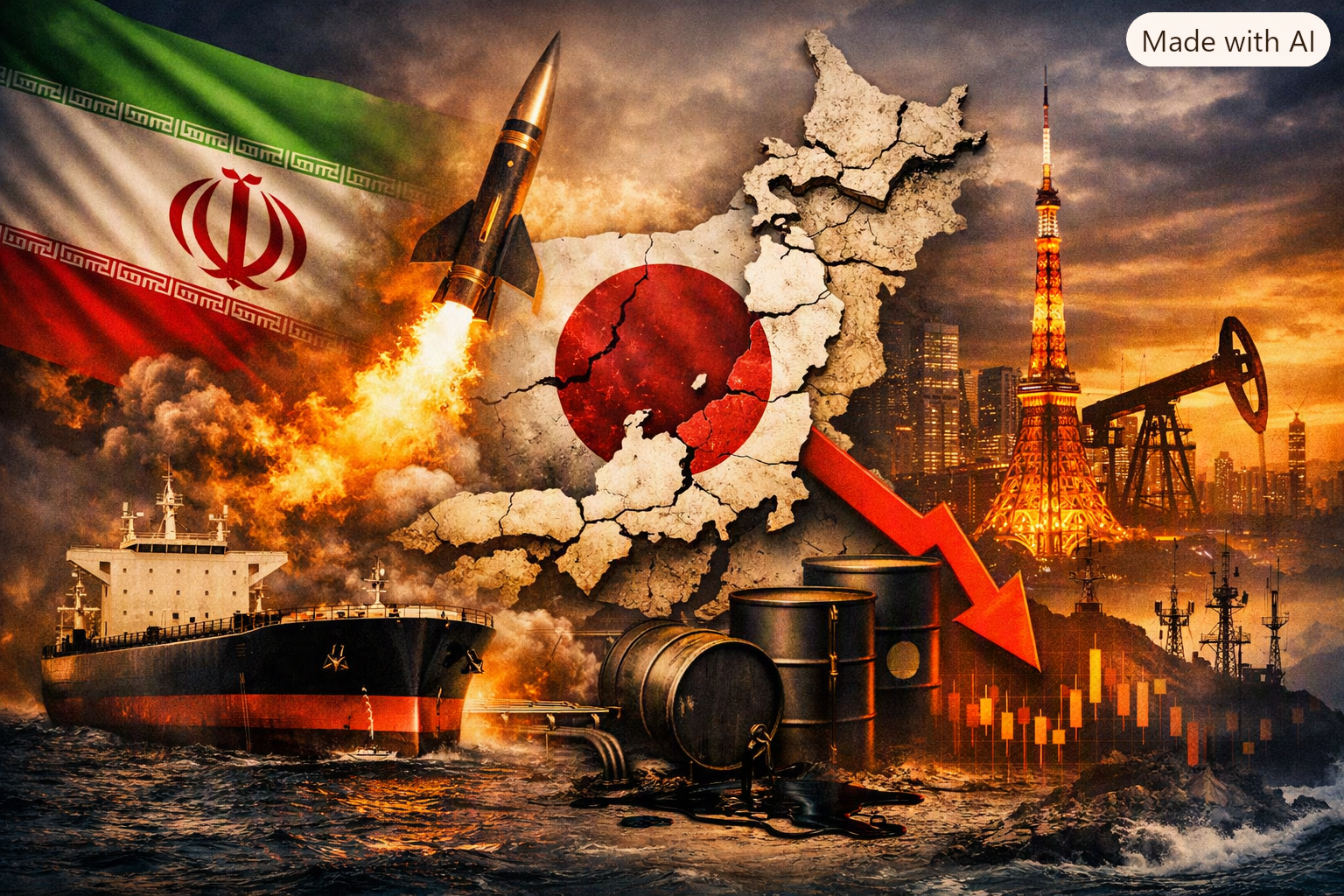
Why Japan Is the Most Exposed Major Economy in the Middle East Crisis
1. Introduction
The U.S.–Israel strike on Iran triggered a rapid escalation across the Middle East, including retaliatory attacks, disruptions to shipping routes, and the effective closure of the Strait of Hormuz. For Japan — one of the most energy‑dependent nations in the world — this crisis is more than a geopolitical event. It is a direct threat to national energy security, economic stability, and maritime safety.
Japan imports 94% of its crude oil from the Middle East, and 20% of the world’s oil and LNG normally passes through the Strait of Hormuz. As global tensions rise, Japan has become the most exposed major economy.
This article explains why Japan is uniquely vulnerable, how the crisis affects its economy and security, and what strategic shifts may follow.
2. Japan’s Heavy Dependence on Middle Eastern Oil
2.1 Crude Oil: 94% from the Middle East
Japan’s energy structure is built on Middle Eastern crude:
- UAE: 43%
- Saudi Arabia: 39%
- Kuwait, Qatar, and others: remaining share
With the Strait of Hormuz disrupted, Japan faces:
- Delayed shipments
- Higher insurance premiums
- Increased transportation risks
- Pressure on domestic refineries
Japan’s energy system is designed around Middle Eastern crude specifications, making rapid diversification difficult.
2.2 LNG and LPG: More Stable but Still Sensitive
Japan has diversified LNG imports over the past decade:
- Middle East LNG dependence dropped from 29% (2013) to 11% (2025)
- LPG dependence is only 3%, with 90 days of reserves
This provides some stability, but crude oil remains the backbone of Japan’s energy supply.
3. Economic Shock: Yen, Inflation, and Market Volatility
3.1 Yen Depreciation Accelerates
Higher oil prices weaken the yen, which recently approached 158–159 per USD. A weaker yen increases import costs, amplifying the energy shock.
3.2 Inflation Pressure
Economic models show:
- GDP could fall by 0.18%
- Consumer prices could rise by 0.3%
- Logistics and manufacturing costs increase sharply
Energy‑driven inflation is one of Japan’s most persistent vulnerabilities.
3.3 Stock Market Reaction
Foreign investors have turned into net sellers, causing volatility in:
- Nikkei 225
- Shipping stocks
- Refinery and energy‑related sectors
Japan’s market reacts quickly to Middle Eastern instability.
4. Maritime Security Risks
4.1 Tanker Attacks and Drone Threats
Iran has attacked more than a dozen vessels in recent weeks. Japan‑bound tankers face risks of:
- Missile strikes
- Drone attacks
- Naval harassment
- Sea mines
The Middle East has become one of the most dangerous shipping zones in the world.
4.2 Japan’s Diplomatic Efforts
Japan’s Foreign Minister has contacted Iran nine times since March to secure safe passage for Japanese vessels. Japan is also coordinating with:
- The U.S.
- Gulf states
- International maritime coalitions
Diplomacy is Japan’s primary tool for protecting its energy lifeline.
5. Japan’s Strategic Response
5.1 POWERR GX: Energy Security Reform
Japan is accelerating reforms under the POWERR GX framework:
- Strengthening nuclear power
- Diversifying crude oil sources
- Expanding strategic reserves
- Supporting alternative shipping routes
- Enhancing maritime insurance systems
This marks a shift toward greater energy autonomy.
5.2 Long‑Term Energy Diversification
Experts argue Japan must:
- Modify refineries to accept non‑Middle Eastern crude
- Increase renewable and nuclear energy
- Reduce dependence on maritime imports
- Build a more resilient domestic energy system
The Iran conflict has become a catalyst for long‑term structural change.
6. Why Japan Is the Most Exposed Major Economy
Japan’s vulnerability is shaped by several structural factors:
- Highest Middle Eastern oil dependence among major economies
- Weak currency amplifying import costs
- Low domestic energy self‑sufficiency
- Limited alternative shipping routes
- High sensitivity to global oil price fluctuations
International analysts describe Japan as “the first country to be hit” in any Middle Eastern energy crisis.
7. Conclusion
The Iran conflict has exposed Japan’s deep energy vulnerabilities. With crude oil supply threatened, the yen weakening, and maritime risks rising, Japan faces a multi‑layered crisis affecting its economy, diplomacy, and national security.
Japan’s response — through diversification, strategic reserves, and diplomatic engagement — will shape its future energy stability and geopolitical role in the Indo‑Pacific.
The Middle East crisis is not just a regional conflict. For Japan, it is a turning point.
🔗 Internal Links
Related Article
How a U.S.–Israel Strike on Iran Impacts Japan: Energy, Security, and Geopolitical Risks

コメント